Learning to Meditate
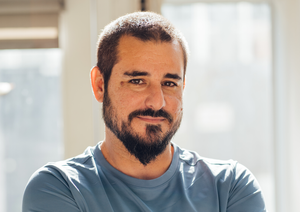
By Joaquin Brown, CTO, Yoga Wake Up
A few weeks ago, Lizzie and I finished our Yoga Teacher Training.
We'd been working toward it for months, studying on weekends, in the gaps between everything else a life and a company create. It was one of the more demanding things I have done in a minute, and also one of the more worthwhile.
I went in expecting to come out knowing more about sequences, alignment, the architecture of a good class. And I did learn those things. But the part that surprised me was something else entirely.
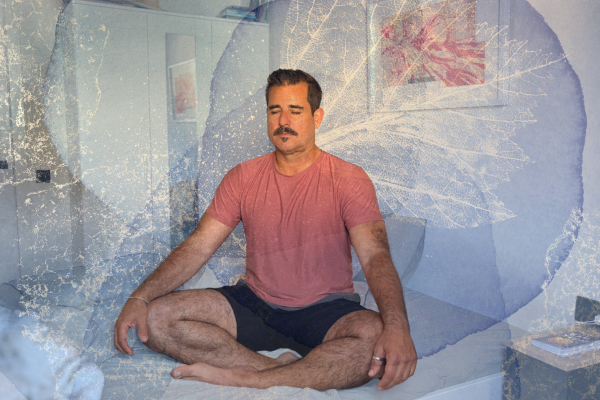
Joaquin and Lizzie just completed Yoga Teacher Training together. Through it, Joaquin started meditating seriously for the first time, using a technique Lizzie brought home from a 10-day Vipassana retreat. This is the honest story of what that's been like. No pitch at the end. Just something he wanted to share.
Yoga is more than I remembered
But I already knew, in the way you can know something without fully living it, that yoga is far more than asanas. In its classical form it's an eight-limbed system. The postures most of us think of as yoga are one of those limbs. One. The other seven are equally ancient, equally serious, and in many ways more central to what yoga is actually trying to do.
One of those limbs is a form of meditation called Dharana.
YTT didn't teach me this for the first time. It made me lean into it in a way I never had before. By the end of training, I understood that if I was going to take yoga seriously, I needed to take meditation seriously too. And for the first time, I was ready to.
Where the technique came from
About two years ago, Lizzie did a 10-day silent Vipassana retreat.
Ten days of silence. No phone, no reading, no eye contact, no speaking. Just sitting with yourself and whatever comes up. I watched her come back from it changed in a way that was quiet and real. Not dramatic. Just more settled. Like she'd found something solid inside herself and now knew where it was.
She'd learned a technique while she was there. Simple, ancient, and completely portable. You find a comfortable position. You close your eyes. And you bring your attention to one specific point: the sensation of breath at the space between your nostrils and your upper lip. The feeling of air arriving and leaving. That's it. Nothing else.
When the mind wanders, you don't fight it. You observe it. You notice where it went, gently, without judgment, and you bring your attention back. That's the whole practice.
She tried to teach it to me at the time. I tried it once, decided my mind was too busy for this, and went back to my regular routine. I wasn't ready.
YTT made me ready. We started meditating together in the mornings.
What it has actually been like
I started with 10 minutes. One bell at the beginning, one in the middle and one at the end.
The first sessions were humbling in a way I hadn't expected. I am someone who builds things, who solves problems, who moves quickly from one thought to the next. Sitting still and focusing on one small physical sensation for ten minutes was genuinely hard. My mind went everywhere. To things I needed to do, to things I'd said, to things I was worried about. The sensation of breath at my nostrils was hardly noticeable and it was hard to maintain my focus there.
But here's what I've come to understand, sitting with this practice now over several months: meditation isn't about controlling the mind. It's about observing it. You watch it wander. You notice where it goes, what it reaches for, what it's carrying. And then, without judgment and without frustration, you bring your attention back to the breath.
That's the practice. Not stillness. Not emptiness. Just patient, curious observation.
I've started to think of it as exploration. Every session is a small expedition into my own inner landscape. Some mornings the terrain is relatively clear. Other mornings it is absolutely not. But I'm learning to be curious about what I find there rather than trying to change it. What's here today? What is my mind doing with this particular morning? That quality of curious noticing is what keeps drawing me back.
I'm now up to 30 minutes. Two bells during the session, small quiet markers that let me know time is passing without having to open my eyes and check. My mind still wanders, often. But I notice it faster now, and I return a little more easily, and there is something about starting the day this way that I find hard to put precisely into words but wouldn't trade for anything.
It doesn't feel like transformation. It feels like paying attention to something I'd been walking past for years.
If you've ever been curious about meditation, I'd love to share more of this journey with you. And especially if you've always assumed it wasn't for you, I'd gently push back on that. I assumed the same thing for a long time. I'm glad I was wrong.
More soon.